
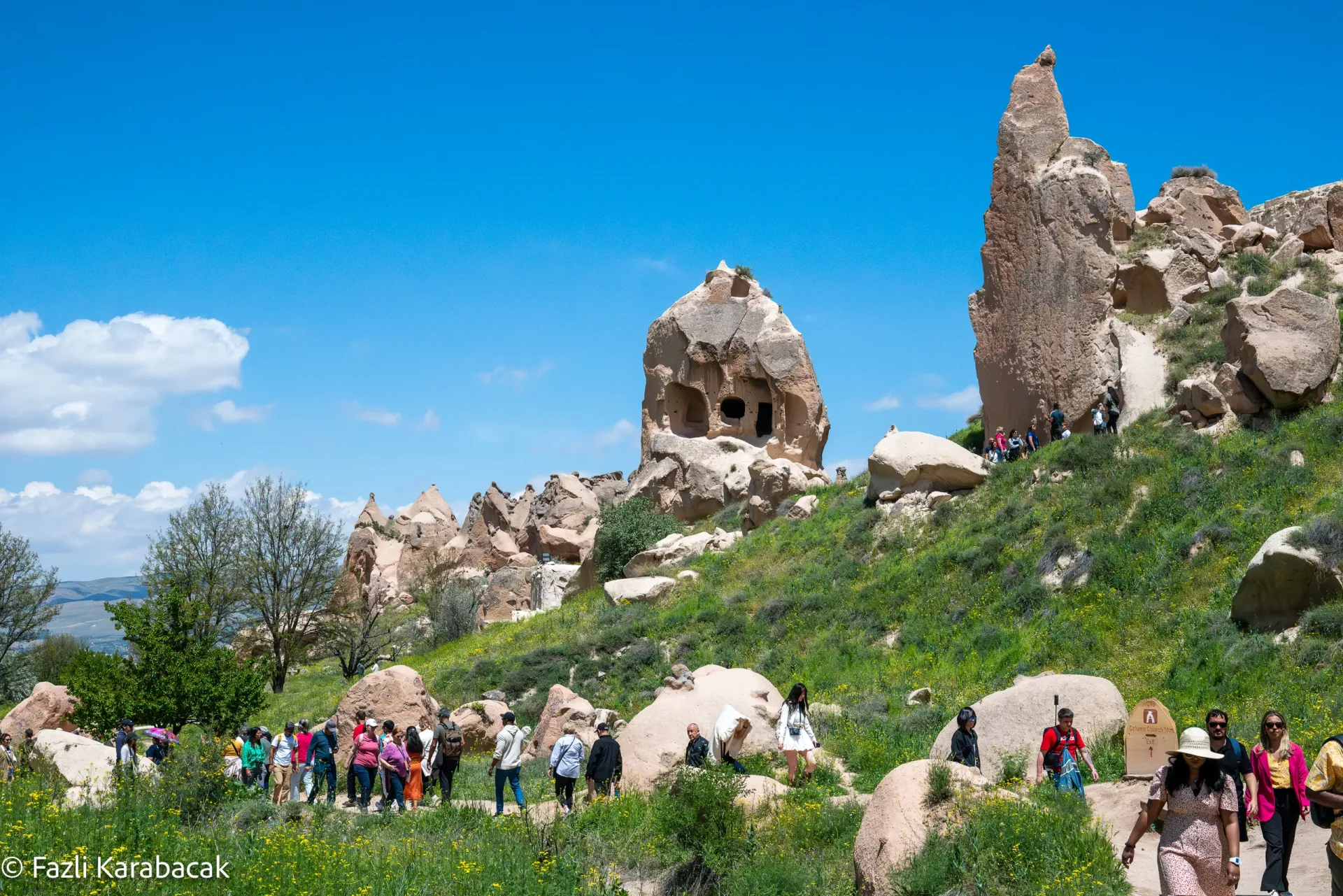
What is Paşabağ?
Paşabağ — also called Monks Valley — is one of Cappadocia's most photographed landscapes, located just 1 km from the Zelve Open-Air Museum entrance on the road between Göreme and Avanos. The valley is famous for two things: its unusual concentration of multi-capped fairy chimneys, and its long history as a hermitage for early Christian monks.
The Three-Headed Mushroom Chimneys
Most fairy chimneys in Cappadocia have a single capstone — a piece of harder basalt sitting atop a softer pillar of volcanic tuff that the rain and wind have not yet eroded away. Paşabağ is unusual because erosion here has split many of the capstones into two or three separate sections. The result is the famous "three-headed mushroom" silhouettes that appear on almost every postcard of Cappadocia and have become the unofficial symbol of the region.
The tallest formations reach 15 to 20 metres. Standing among them feels like walking through a forest of stone giants. The colour shifts from pale cream in midday light to deep gold and rose at sunset.
Saint Simeon's Hermitage
Paşabağ is also known as Monks Valley because hermit monks carved cells, chapels, and small living quarters into the tall fairy chimneys here from the 4th to the 13th century. The most famous is the chapel of Saint Simeon (Aziz Simeon Kilisesi) — a small rock-cut hermitage carved into one of the three-headed mushrooms.
A narrow rock-cut staircase leads up to the chapel entrance, several metres above the valley floor. Inside, you can still see the carved cell where the hermit lived, the simple prayer niche oriented toward Jerusalem, and the small window through which food was reportedly passed by the local community. The chapel commemorates Simeon the Stylite, a 5th-century Syrian ascetic who became famous for living atop a pillar — an apt patron for a valley of stone pillars.
Paşabağ and Zelve
Paşabağ and Zelve are administratively connected — a single ticket covers both sites, and they are usually visited together. Zelve is the abandoned cave village just down the road, with three valleys to explore and a rock-cut mosque. Paşabağ is the smaller, more iconic stop. Together they form one of the most rewarding half-day excursions in Cappadocia.
Practical Information
Paşabağ is open daily from 8:00am to 7:00pm in summer and 8:00am to 5:00pm in winter. The entrance ticket is shared with Zelve Open-Air Museum (approximately €12 / 400 TL as of 2026). The Turkish Museum Card is accepted. The site has a small car park, a few souvenir stalls, and basic toilets. There are no facilities inside the valley itself.
Best time to visit: Early morning before the tour buses arrive, or in the last hour before sunset when the light is most photogenic. Allow 20 to 40 minutes for the main loop and a short climb up to Saint Simeon's chapel.
Getting there: Paşabağ is 10 km from Göreme, signposted from the Avanos road. It is included on virtually every standard Red (North) Tour itinerary and on our own Cappadocia Hidden Gems Day Tour.
Visit Paşabağ on a Guided Tour
Paşabağ is featured on the Cappadocia Hidden Gems Day Tour, paired with Devrent Valley, Zelve, Çavuşin, Rose Valley, and Kaymaklı Underground City. A guide explains the geological process behind the multi-capped chimneys and the history of the hermit communities who once lived inside them.